Battery Manufacturing Machines: A Guide to Modern Battery Production Equipment
Battery manufacturing machines are specialized industrial systems used to convert battery materials into electrodes, cells, modules, and finished battery packs. Modern production lines use equipment for material mixing, electrode coating, drying, pressing, slitting, cell assembly, electrolyte filling, formation, testing, and quality inspection.
The exact equipment depends on battery chemistry, cell format, production capacity, and manufacturing process. Lithium-ion battery production, for example, commonly involves electrode manufacturing, cell assembly, and formation and grading stages.
Types of Battery Manufacturing Machines
Battery Material Mixing Machines
Mixing equipment combines active materials, conductive additives, binders, and other components to produce a consistent electrode slurry. Industrial mixing systems are designed to control dispersion and material uniformity before the coating stage.
Electrode Coating Machines
Coating machines apply electrode slurry onto metal current-collector foils. Roll-to-roll and slot-die coating technologies are used in different battery manufacturing environments, including research and larger-scale production.
Electrode Drying Equipment
After coating, the electrode material requires controlled drying to remove solvents and establish the required electrode structure. Drying systems can use controlled air, infrared, ultraviolet, or other processing technologies depending on the manufacturing method.
Calendering Machines
Calendering equipment compresses coated electrode materials between rollers. This process helps control electrode thickness, density, and surface characteristics before subsequent cutting and cell assembly operations.
Slitting and Cutting Machines
Slitting machines divide large coated electrode rolls into narrower sections. Precision cutting and slitting are important because electrode dimensions must correspond with the intended cell design.
Battery Cell Assembly Equipment
Stacking and Winding Machines
Battery cells can use different internal arrangements depending on their format. Stacking machines arrange electrode and separator layers, while winding equipment forms layered structures into a controlled roll configuration.
Electrolyte Filling Machines
Electrolyte filling equipment introduces electrolyte into assembled cells under controlled manufacturing conditions. Accurate filling is important for consistent electrochemical performance.
Sealing and Welding Equipment
Automated welding and sealing systems join cell components and close the cell enclosure. Different technologies can be used according to whether the battery uses pouch, cylindrical, or prismatic construction.
Battery Formation and Testing Machines
Formation Equipment
Formation is an important stage in lithium-ion battery manufacturing. Formation equipment applies controlled electrical cycles to newly assembled cells so their electrochemical characteristics can be established and evaluated.
Battery Testing Equipment
Battery testing machines measure characteristics such as voltage, current, capacity, impedance, cycle performance, and temperature behavior. Research facilities use battery cyclers, potentiostats, environmental chambers, and other analytical equipment for battery evaluation.
Quality Inspection Systems
Quality-control equipment can inspect electrode dimensions, surface conditions, cell construction, electrical characteristics, and other manufacturing parameters. Automated inspection can help identify process variations before batteries move to later production stages.
Battery Pack Assembly Machines
Module Assembly Equipment
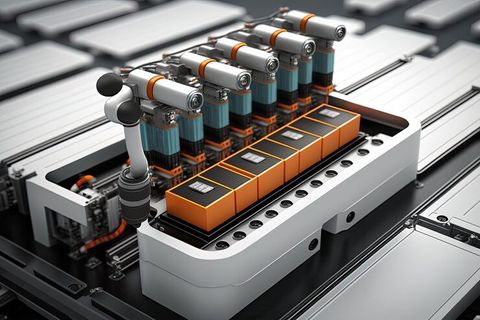
Module assembly systems connect individual battery cells into larger groups. Equipment may include positioning systems, electrical connection equipment, fastening systems, insulation components, and inspection technologies.
Battery Pack Testing Equipment
Pack-level testing evaluates electrical and operational characteristics after cells or modules have been integrated. Testing may include electrical measurements, thermal monitoring, communication checks, and controlled performance tests.
Automation in Battery Manufacturing
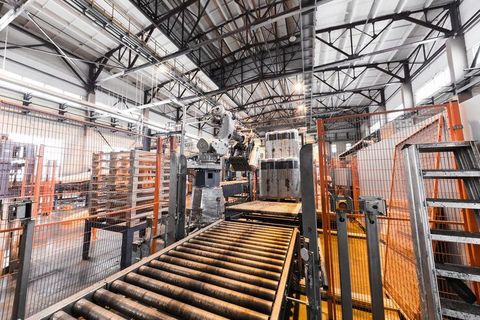
Automation is increasingly used throughout battery production to improve process consistency and support high-volume manufacturing. Automated systems can coordinate material handling, electrode processing, cell assembly, inspection, and testing.
Modern battery research facilities demonstrate the range of equipment involved in production development, including coating lines, dry rooms, cell assembly equipment, battery cyclers, and advanced characterization systems.
Factors to Consider in Battery Production Equipment
Battery Chemistry
Lithium-ion, solid-state, flow, and other battery technologies can require different manufacturing processes and equipment. Solid-state battery development, for example, can involve tape casting, specialized coating, calendaring, controlled-atmosphere processing, and other techniques.
Cell Format
Equipment requirements also vary according to cylindrical, prismatic, and pouch cell designs. Cell geometry affects electrode processing, assembly, sealing, inspection, and testing requirements.
Production Capacity
Production equipment can range from laboratory and pilot-scale machines to highly automated industrial production lines. The appropriate configuration depends on the intended manufacturing volume and process requirements.
Quality Control
Battery manufacturing requires close control of dimensions, materials, moisture, electrical characteristics, and process conditions. Dry-room environments and specialized testing equipment are used in various battery manufacturing facilities to control sensitive production conditions.
Conclusion
Battery manufacturing machines form the foundation of modern battery production. Equipment for mixing, coating, drying, calendering, slitting, cell assembly, formation, testing, and pack integration works together to transform raw materials into functional energy-storage products.
As battery technologies develop, manufacturing equipment is also evolving toward greater automation, improved process control, advanced inspection, and more efficient production methods. Understanding each machine's role helps explain how modern battery cells and energy-storage systems are manufactured.