Industrial Automation Components: A Guide to Essential Technologies and Applications
Industrial automation components have become a growing choice for manufacturers seeking more consistent, efficient, and connected production environments. From factories and warehouses to process industries and packaging lines, automation technologies appeal to a broad range of users because they can support machine control, monitoring, safety, motion management, and industrial communication. Understanding the different components makes it easier to see how automated systems are structured and where individual technologies fit into an industrial application.
The industrial automation landscape has evolved from basic electrical control systems into highly connected architectures that combine sensors, programmable controllers, drives, robotics, software, and communication networks. Major automation technology providers such as Siemens, Rockwell Automation, Schneider Electric, ABB, and Mitsubishi Electric offer components for different industrial requirements. With so many technologies and configurations available, there is something for almost every type of manufacturing and process-control need.
Programmable Logic Controllers for Core Machine Control
For those interested in core industrial machine control, programmable logic controllers (PLCs) are among the most recognizable automation components. PLCs receive information from field devices, process programmed instructions, and control connected equipment according to defined logic.
Examples include Siemens SIMATIC, Rockwell Automation Allen-Bradley ControlLogix, and Mitsubishi Electric MELSEC PLC families. These platforms are commonly associated with manufacturing equipment, conveyor systems, assembly machines, and process-control applications.
PLC-based automation appeals to engineers and manufacturers that need structured control over sequential operations. Depending on the architecture, PLC systems can also integrate with human-machine interfaces, industrial networks, safety equipment, and variable frequency drives. This makes PLC technology a central part of many industrial control systems.
Sensors for Monitoring Industrial Processes
For those focused on measurement and real-time monitoring, industrial sensors provide an important connection between physical processes and automation systems. Sensors can detect conditions such as position, temperature, pressure, proximity, level, flow, and vibration.
Recognizable manufacturers include SICK, ifm, and Pepperl+Fuchs, which produce technologies used across manufacturing and process environments. For example, proximity sensors can detect the presence of an object, while temperature sensors can monitor equipment or process conditions.
Sensor technology appeals to users who need accurate information from machinery and production lines. When connected to PLCs and industrial networks, sensors can provide the input required for automated decisions, equipment monitoring, and process optimization.
Motor Drives for Automated Motion
For applications involving motors and controlled movement, variable frequency drives (VFDs) and servo drives are important industrial automation components. These devices can regulate motor operation and support controlled acceleration, speed, torque, and positioning.
Examples include ABB ACS drives, Siemens SINAMICS, and Rockwell Automation PowerFlex drive systems. Such technologies are often found in conveyors, pumps, fans, machine tools, material-handling equipment, and production machinery.
This segment appeals to manufacturers that require controlled motor performance rather than simple on-and-off operation. Servo systems can provide more precise positioning for applications such as packaging, robotics, and automated assembly. The appropriate drive technology generally depends on motor type, control requirements, load characteristics, and system architecture.
Human-Machine Interfaces for Operator Interaction
For those interested in operator-friendly automation, human-machine interfaces (HMIs) provide a visual connection between people and industrial equipment. HMI panels can display production information, alarms, machine conditions, operating parameters, and diagnostic messages.
Well-known examples include Siemens SIMATIC HMI, Schneider Electric Harmony interfaces, and Rockwell Automation PanelView Plus systems. These products are commonly integrated with PLCs and other control equipment.
HMIs appeal to operators and maintenance teams because information can be presented in a more accessible format than traditional control panels alone. Depending on the application, an HMI may allow authorized personnel to adjust operating settings, review alarms, monitor equipment status, or identify potential process issues.
Industrial Robotics for Automated Production
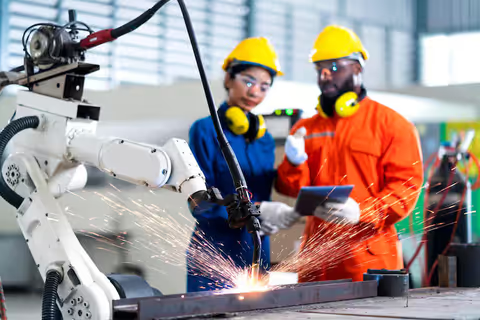
For manufacturers exploring advanced automation, industrial robots represent a specialized segment of the automation components ecosystem. Robots can perform repetitive operations such as assembly, material handling, welding, palletizing, and machine tending.
Recognizable robotics companies include ABB, FANUC, and Yaskawa Motoman. Their industrial robotic systems are used across automotive, electronics, logistics, metalworking, and general manufacturing environments.
Robotic automation often appeals to facilities where repetitive or precisely controlled movements form an important part of production. Robots can be integrated with sensors, PLCs, vision systems, safety equipment, and industrial communication networks. Collaborative robots, or cobots, represent another category designed for applications where human-machine interaction is part of the operating environment.
Industrial Safety Components for Controlled Operations
For those prioritizing machine and workplace safety, industrial safety components form a critical part of an automation architecture. These technologies can help monitor hazardous areas, stop machinery when defined conditions occur, and support safety-related control functions.
Examples include Pilz safety controllers, SICK safety light curtains, and Schneider Electric Preventa safety products. Depending on the system, safety components may include emergency-stop devices, safety relays, interlock switches, light curtains, scanners, and safety PLCs.
Safety automation appeals to facilities where machinery involves moving parts, restricted areas, or other identified hazards. System design typically considers applicable standards, risk assessments, machine characteristics, and local regulatory requirements rather than treating safety equipment as a standalone component.
Industrial Communication and Networking
For those working with connected factories, industrial communication systems provide the infrastructure through which automation devices exchange information. Modern production environments may contain PLCs, sensors, drives, HMIs, robots, and supervisory systems that need reliable communication.
Common technologies and platforms include PROFINET, EtherNet/IP, and EtherCAT. Companies such as Siemens, Rockwell Automation, and Beckhoff are associated with industrial networking and automation ecosystems supporting these technologies.
Industrial networking appeals to users developing connected manufacturing systems and industrial IoT architectures. Network design can influence communication speed, device integration, diagnostics, cybersecurity, and system scalability. Depending on the application, wired Ethernet, fieldbus technologies, or industrial wireless communication may form part of the overall architecture.
All-in-One Automation Platforms and Integrated Systems
For those looking at the broader automation picture, integrated platforms combine several industrial automation functions within a coordinated ecosystem. Instead of considering each component independently, manufacturers can connect PLCs, HMIs, drives, safety systems, robotics, software, and networking technologies.
Examples include Siemens TIA Portal, Rockwell Automation Studio 5000, and Schneider Electric EcoStruxure Automation Expert. These platforms can provide engineering and configuration environments that bring multiple automation technologies together.
This approach appeals to engineering teams managing complex production environments because integrated architectures can simplify system coordination and data exchange. The exact combination depends on the application, existing equipment, communication requirements, and long-term automation strategy.
Specialized Components for Industry-Specific Applications
For those with specialized manufacturing requirements, automation components can be selected around particular industries and processes. Food and beverage production, pharmaceuticals, automotive manufacturing, electronics, energy, and material handling can each require different combinations of automation technologies.
Examples include Cognex machine vision systems, Keyence vision and sensing technologies, and Bosch Rexroth motion-control solutions. Machine vision, for example, can support inspection and identification tasks, while advanced motion technologies can be applied to precision machinery.
This specialist segment appeals to facilities where standard automation functions are not enough to address a particular production challenge. Application-specific components can be integrated with broader PLC, HMI, robotics, networking, and safety architectures.
Conclusion
The diversity of industrial automation components means there are technologies suited to many manufacturing, process-control, motion, monitoring, and safety requirements. PLCs, sensors, drives, HMIs, robots, networking equipment, and specialized systems can work individually or as interconnected automation architectures. Exploring the available component categories and understanding how they interact can help engineers and manufacturers develop automation systems that are better aligned with their operational requirements, technical environment, and long-term production objectives.