Automation Equipment Manufacturing: A Complete Guide
Automation equipment manufacturing involves designing and producing machines and control systems that perform industrial tasks with limited direct human intervention. These systems can support material handling, assembly, machining, inspection, packaging, and other production activities. Manufacturing automation commonly combines programmable machines, sensors, control systems, robotics, and industrial software.
The field connects mechanical engineering, electrical engineering, control technology, robotics, and computer systems. Automation equipment can range from dedicated machines designed for one production task to programmable systems capable of handling different product configurations.
Importance of Automation Equipment Manufacturing
Automation equipment plays an important role in modern manufacturing because production environments increasingly require consistent processes, reliable quality control, and accurate machine operation. Programmable systems can execute predefined sequences repeatedly while sensors can provide information about machine conditions and production processes.
Industrial automation also supports applications where repetitive, precise, or continuous operations are required. Depending on the production environment, equipment may include automated assembly machines, robotic cells, conveyors, inspection systems, and programmable control systems.
Key Components of Automation Equipment
Programmable Logic Controllers
Programmable Logic Controllers, commonly called PLCs, are industrial computers used to monitor inputs and control machine outputs. They can receive information from sensors and execute programmed instructions to operate motors, valves, actuators, and other equipment.
Sensors and Control Systems
Sensors collect information such as temperature, position, pressure, speed, and proximity. Control systems process this information and coordinate machine operations. Together, these components help automation equipment respond to changing production conditions.
Industrial Robotics
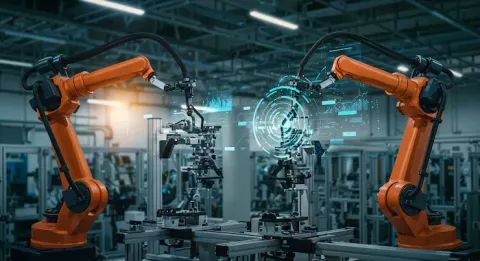
Industrial robots are used for applications such as material handling, welding, assembly, palletizing, and machine tending. Robotic systems can be integrated with sensors, controllers, safety equipment, and production software.
Machine Vision
Machine vision systems use cameras, lighting, image-processing hardware, and software to inspect products or identify specific characteristics. They can support automated quality inspection and measurement processes.
Types of Automation Equipment
Automated Assembly Equipment
Automated assembly equipment combines components through programmed mechanical processes. Such systems may use robotic arms, feeders, conveyors, sensors, and specialized tooling to perform repeated assembly operations.
Material Handling Equipment
Automated material handling equipment moves components and products between different stages of production. Conveyors, automated guided systems, robotic handlers, and lifting mechanisms are examples of technologies used for this purpose.
CNC and Machining Automation
Automation can be integrated with CNC machines to support loading, unloading, tool management, inspection, and production monitoring. These systems can connect machining operations with broader manufacturing workflows.
Automated Inspection Systems
Automated inspection equipment uses sensors, measurement systems, and machine vision technologies to evaluate products against predefined requirements. This can help manufacturers identify process variations and quality issues.
Automation Equipment Manufacturing Process
System Design
Manufacturing begins with defining the production requirements and developing a machine architecture. Engineers determine mechanical components, electrical systems, control hardware, sensors, safety mechanisms, and software requirements.
Component Manufacturing and Assembly
Individual mechanical and electrical components are produced or sourced according to the system design. The equipment is then assembled, wired, programmed, and integrated into a functional automation system.
Programming and Integration
PLC programs, robotic controls, human-machine interfaces, and other software components are configured during integration. Communication between sensors, controllers, motors, robots, and other equipment is tested before production use.
Testing and Validation
Testing evaluates machine operation, accuracy, safety functions, communication, and process performance. Manufacturers may conduct functional testing and controlled production trials before the equipment is placed into regular operation.
Benefits of Manufacturing Automation
Automation equipment can provide several operational benefits when properly designed and integrated. These include greater process consistency, repeatable machine operation, automated data collection, and improved control over repetitive production tasks.
Automation can also connect production equipment with industrial data systems. This creates opportunities for monitoring machine conditions, analyzing production information, and identifying process variations.
Factors to Consider
When studying or planning automation equipment, several technical factors are important. These include production volume, product variation, machine speed, accuracy requirements, safety requirements, available floor space, control architecture, maintenance requirements, and compatibility with existing manufacturing systems.
The level of automation should also correspond to the production process. Fixed automation may be appropriate for highly repetitive operations, while programmable or flexible automation can accommodate greater product variation. IEEE describes manufacturing automation as ranging from dedicated hard automation to flexible systems using programmable machines and robotics.
Future of Automation Equipment Manufacturing
Automation equipment is increasingly connected with digital manufacturing technologies, industrial data systems, robotics, machine vision, and artificial intelligence. Modern automation architectures can combine physical machinery with software-based monitoring and analysis.
The broader development of smart manufacturing is also encouraging greater integration between machines, control systems, production data, and enterprise technologies. These developments are changing how manufacturers approach equipment design, process monitoring, and production management.
Conclusion
Automation equipment manufacturing brings together mechanical systems, electronics, robotics, sensors, control technology, and industrial software. From automated assembly and material handling to machine vision and CNC automation, these technologies support a wide range of manufacturing processes.
Understanding the components, manufacturing stages, control systems, and applications of automation equipment provides a useful foundation for studying modern industrial automation and smart manufacturing.