Industrial Sensors: Types, Applications, Benefits and Selection Guide
Industrial sensors are an important part of modern automation, manufacturing, process control, and equipment monitoring. They collect information about physical conditions such as temperature, pressure, position, flow, level, vibration, and object presence, then provide signals that control systems can interpret.
As factories adopt smart manufacturing and connected industrial systems, accurate sensor data has become increasingly important. Sensors provide the information that allows programmable logic controllers (PLCs), SCADA systems, industrial computers, and other control equipment to monitor and respond to changing conditions.
This guide explains the major types of industrial sensors, how they work, their applications, and the factors to consider when selecting a sensor for an industrial environment.
What Are Industrial Sensors?
An industrial sensor is a device that detects a physical condition or change and converts it into a usable electrical or digital signal.
Depending on the technology, a sensor may detect:
- Temperature
- Pressure
- Flow
- Liquid or material level
- Object presence
- Position and distance
- Vibration
- Humidity
- Gas concentration
- Force or weight
- Speed and rotation
The resulting information can be transmitted to a PLC, HMI, SCADA platform, industrial computer, or other automation system.
How Industrial Sensors Work
A basic sensing process can be described as:
Physical condition → Detection → Signal conversion → Control system → Automated response
For example, a temperature sensor can detect a change in process temperature and transmit a signal to a controller. The control system can then use that information to maintain the required operating conditions.
Modern sensor technologies can also provide diagnostic information and digital communication, supporting connected factory and Industrial IoT applications.
Why Industrial Sensors Are Important
Industrial sensors provide the data required for monitoring and controlling automated equipment.
Supporting Industrial Automation
Automation systems depend on continuous information from machines and processes. Sensors can detect whether a component is present, whether a machine has reached a particular position, or whether a process variable has moved outside its desired range.
This information allows control systems to coordinate production operations.
Improving Process Monitoring
Temperature, pressure, flow, and level sensors can provide continuous information about industrial processes. Operators can use this data to identify changes and maintain process conditions.
Supporting Predictive Maintenance
Vibration, temperature, pressure, and other sensor measurements can be used for equipment condition monitoring. Changes in sensor readings may help maintenance teams investigate developing equipment problems before they result in unexpected downtime.
Supporting Quality Control
Sensors can help verify product position, dimensions, presence, temperature, and other process characteristics. This can contribute to consistent manufacturing and automated inspection processes.
Major Types of Industrial Sensors
Different industrial applications require different sensing technologies. The most common categories include proximity, photoelectric, temperature, pressure, flow, level, vibration, and position sensors.
Proximity Sensors
Proximity sensors detect objects without requiring physical contact.
Common types include:
- Inductive proximity sensors
- Capacitive proximity sensors
- Magnetic proximity sensors
- Ultrasonic proximity sensors
Inductive sensors are particularly useful for detecting metallic objects, while capacitive sensors can detect a broader range of materials, including some liquids and non-metallic materials.
Applications include:
- Conveyor systems
- Assembly machines
- Robotics
- Machine positioning
- Part detection
- Industrial equipment
Photoelectric Sensors
Photoelectric sensors use light to detect objects or changes in a sensing area.
Common configurations include:
- Through-beam
- Retro-reflective
- Diffuse-reflective
They are widely used in packaging, material handling, conveyor systems, counting applications, and automated production lines.
Temperature Sensors
Temperature sensors measure thermal conditions in equipment and processes.
Common technologies include:
- Thermocouples
- RTDs
- Thermistors
- Infrared sensors
They can be used in industrial ovens, furnaces, motors, HVAC systems, manufacturing equipment, and process-control applications.
Pressure Sensors
Pressure sensors measure the pressure of gases or liquids.
They are commonly classified as:
- Gauge pressure sensors
- Absolute pressure sensors
- Differential pressure sensors
Pressure measurement is important in hydraulic and pneumatic equipment, pumps, compressors, pipelines, water treatment systems, and process industries.
Flow Sensors
Flow sensors measure the movement of liquids or gases through pipes and process equipment.
Different technologies include:
- Electromagnetic flow measurement
- Ultrasonic flow measurement
- Coriolis measurement
- Vortex flow measurement
- Turbine flow measurement
The appropriate technology depends on the fluid characteristics, required measurement accuracy, installation conditions, and process requirements.
Level Sensors
Level sensors measure the amount of liquid, powder, or bulk material in a container, tank, or silo.
Common technologies include:
- Float sensors
- Capacitive sensors
- Ultrasonic sensors
- Radar sensors
Level measurement is frequently used in water treatment, chemical processing, storage systems, and industrial production.
Vibration Sensors
Vibration sensors monitor mechanical movement and vibration.
They are particularly useful for condition monitoring of rotating equipment such as:
- Motors
- Pumps
- Fans
- Compressors
- Gearboxes
- Industrial machinery
Vibration information can be analyzed to identify unusual operating conditions and support maintenance planning.
Position and Motion Sensors
Position sensors determine the location or movement of mechanical components.
Examples include:
- Linear encoders
- Rotary encoders
- Magnetic sensors
- Hall-effect sensors
These technologies are commonly associated with CNC machinery, robotics, motion-control systems, and automated production equipment.
Industrial Sensor Applications
Industrial sensors are used across many sectors because different processes require continuous measurement and monitoring.
Manufacturing and Assembly
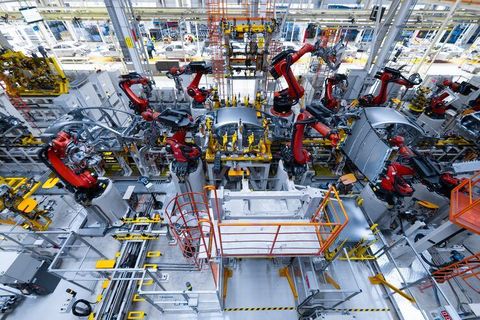
Sensors can detect components, verify positions, count products, monitor temperatures, and provide feedback to automated machinery.
Robotics and Machine Automation
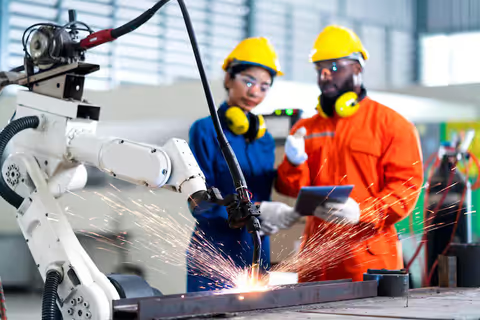
Robotic systems use position, proximity, vision, force, and other sensing technologies to understand their operating environment and perform programmed movements.
Oil and Gas
Pressure, flow, temperature, level, and gas sensors can monitor process conditions across equipment and pipelines.
Water and Wastewater Treatment
Level, pressure, flow, pH, turbidity, and other measurement technologies can support water-treatment processes and monitoring systems.
Food and Beverage Processing
Temperature, level, flow, pressure, and proximity sensors can help monitor production processes and automated equipment.
Pharmaceutical Manufacturing
Accurate process measurement is important for controlled manufacturing environments. Temperature, pressure, flow, humidity, and other sensors may be integrated into monitoring and control systems.
Industrial Sensors and Industry 4.0
Industry 4.0 has increased the importance of connected sensing technologies. Modern industrial sensors can communicate with automation networks and provide information beyond a simple on/off signal.
Digital communication technologies such as IO-Link can provide sensor data and diagnostic information to connected automation systems. This can help integrate sensing into broader industrial data and monitoring architectures.
Smart Sensors
Smart sensors can combine sensing, signal processing, diagnostics, and communication capabilities.
Depending on the technology, they may provide:
- Measurement data
- Diagnostic information
- Device status
- Configuration information
- Communication with automation networks
This makes sensors an important data source for smart manufacturing and Industrial IoT systems.
How to Choose an Industrial Sensor
Selecting an industrial sensor requires more than looking at the measurement type. The operating environment and control-system requirements are also important.
Measurement Requirements
First identify what needs to be measured:
- Temperature
- Pressure
- Distance
- Position
- Flow
- Level
- Vibration
- Humidity
- Gas concentration
- Force
The measurement requirement determines which sensing technology is appropriate.
Sensing Range and Accuracy
Consider the required detection distance, measurement range, resolution, repeatability, and accuracy.
For example, an object-detection application may require a different sensor from a process-control application where continuous and precise measurement is necessary.
Environmental Conditions
Industrial environments may expose sensors to:
- Dust
- Water
- Oil
- Chemicals
- Vibration
- Electromagnetic interference
- High or low temperatures
Protection ratings such as IP65, IP67, and IP69K may be relevant depending on the installation environment. Hazardous-area applications can also require appropriate certifications.
Electrical and Communication Interface
The sensor must be compatible with the control system.
Common interfaces include:
- Discrete digital outputs
- 4–20 mA
- 0–10 V
- IO-Link
- Industrial Ethernet and other network technologies
Compatibility should be confirmed before installation.
Industrial Sensor Comparison
| Sensor Type | Primary Measurement | Common Applications |
|---|---|---|
| Proximity | Object presence | Automation, conveyors, machinery |
| Photoelectric | Object detection | Packaging, counting, material handling |
| Temperature | Thermal conditions | Ovens, motors, process control |
| Pressure | Fluid or gas pressure | Hydraulics, pneumatics, pipelines |
| Flow | Fluid movement | Water, chemicals, process systems |
| Level | Liquid or solid level | Tanks, silos, treatment systems |
| Vibration | Mechanical movement | Motors, pumps, rotating equipment |
| Position | Linear or rotary position | CNC, robotics, motion control |
| Humidity | Moisture level | Storage, cleanrooms, environmental monitoring |
| Load | Force or weight | Weighing and mechanical monitoring |
The appropriate sensor depends on the measurement requirement, material, environment, accuracy requirements, and automation architecture.
Benefits of Industrial Sensor Technology
Industrial sensors can support several areas of industrial operations:
- Real-time process monitoring
- Automated machine control
- Equipment condition monitoring
- Quality inspection
- Production data collection
- Process consistency
- Safety monitoring
- Predictive maintenance
- Industrial IoT connectivity
The value of a sensor is largely determined by the quality and relevance of the information it provides to the control or monitoring system.
Common Challenges With Industrial Sensors
Even a suitable sensor can produce unreliable results if it is incorrectly installed or maintained.
Incorrect Sensor Selection
A sensor designed for one material, temperature range, or sensing distance may not perform appropriately in another application.
Environmental Interference
Dust, moisture, vibration, electromagnetic interference, temperature changes, and chemical exposure can affect sensor performance.
Installation Problems
Incorrect alignment, unsuitable mounting, poor wiring, or improper sensing distance can lead to inconsistent measurements.
Calibration and Maintenance
Some measurement systems require periodic calibration or verification. Maintenance schedules should be based on the sensor technology, application conditions, manufacturer specifications, and required measurement reliability.
Future of Industrial Sensors
Industrial sensing is increasingly connected with automation, machine monitoring, Industrial IoT, and data analytics. Recent industry discussions emphasize the importance of accurate measurement data as factories adopt more automated and data-driven processes.
Future industrial sensor systems are likely to focus on areas such as:
- Connected sensors
- Digital diagnostics
- Edge data processing
- Condition monitoring
- Industrial IoT
- Automated quality inspection
- Energy monitoring
- Smart manufacturing
The continuing development of these technologies means sensors are becoming more than simple detection devices. They are increasingly important sources of operational data for industrial control and monitoring systems.
Conclusion
Industrial sensors provide the measurement and detection capabilities that modern automation systems require. From proximity and photoelectric sensors to temperature, pressure, flow, level, vibration, and position sensors, each technology is designed for particular measurement conditions and applications.
Choosing the right industrial sensor requires careful consideration of the measurement target, sensing range, accuracy, environmental conditions, communication interface, and integration requirements. When appropriately selected and installed, sensors can provide reliable data for industrial automation, process control, machine monitoring, quality control, and smart manufacturing.